

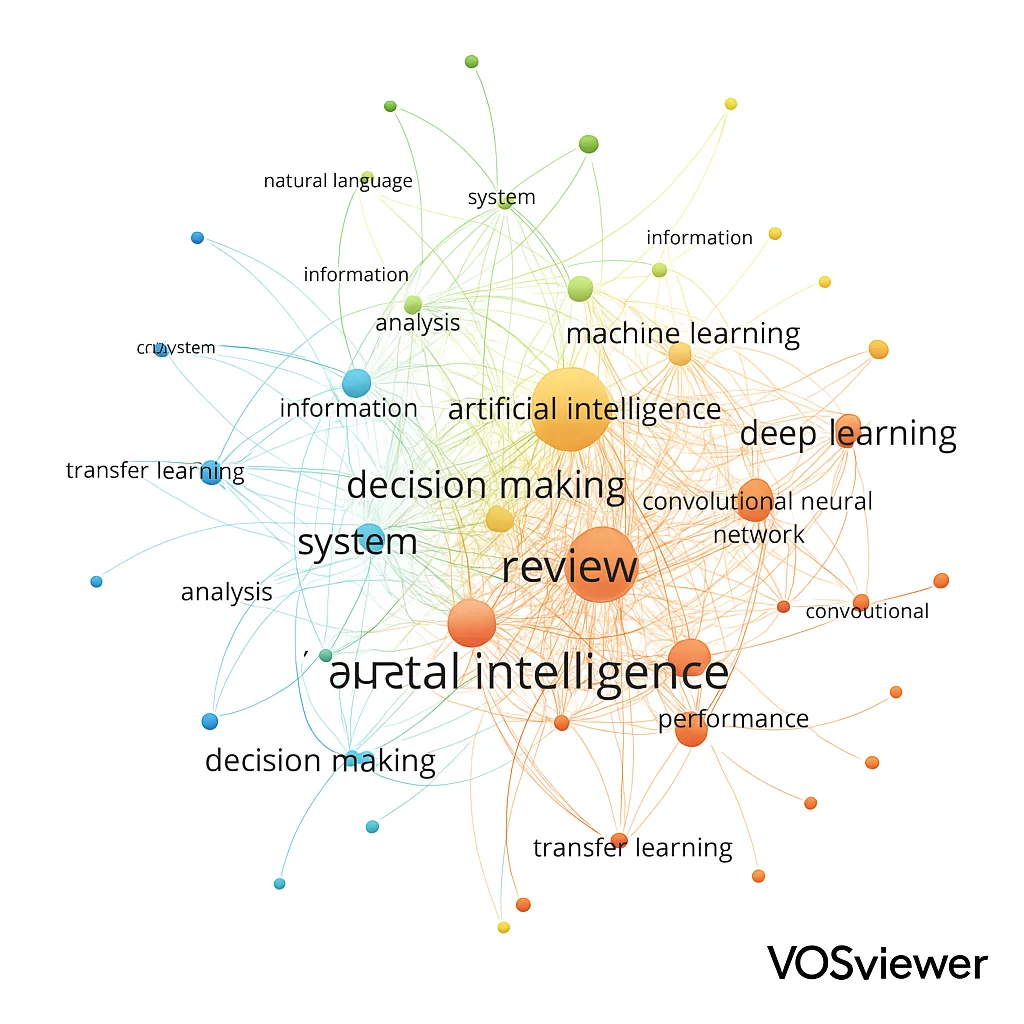
Bibliometric analysis examines the structure of academic literature through quantitative indicators and networks. VOSviewer consulting provides applied guidance as researchers export, clean, map, and assess the limits of their own data.
Service boundary: Database selection, search strategy, screening decisions, academic interpretation, and the final text belong to the researcher. We do not prepare a thesis, article, or publication-ready report on behalf of a researcher.
What is Bibliometric Analysis?
Researchers who want to understand the scope, direction and structure of scientific production can benefit from this type of analysis in multiple ways. The basic gains offered by this method are below:
Topic Intensity Mapping
- Reveals which topics have been studied more in a specific field over time.
- Helps to see which themes are prominent or in the background in the literature.
Determining Publication Trends
- It is analyzed which topics are rising or decreasing according to time intervals.
- In this way, researchers can notice which areas have more current or less studied gaps.
Impact Level Measurement
- It is determined which studies direct the field by being referenced more.
- The most influential authors, institutions and journals in the field can be identified.
Analysis of Collaboration Networks
- Joint work relationships between researchers, institutions or countries are mapped.
- This analysis shows how academic networks are shaped and which groups are producing intensively.
Visualization of Conceptual Structures
- It is visually presented in which contexts keywords are used with each other.
- Relationships between subject clusters become more clearly understood.
What Does It Provide?
- Quantitative analysis of scientific literature on large data sets
- Making more conscious decisions when creating academic strategy
- Analysis of national and international publication policies
- Facilitates thesis, article or project planning based on field analysis
How to Perform Bibliometric Analysis?
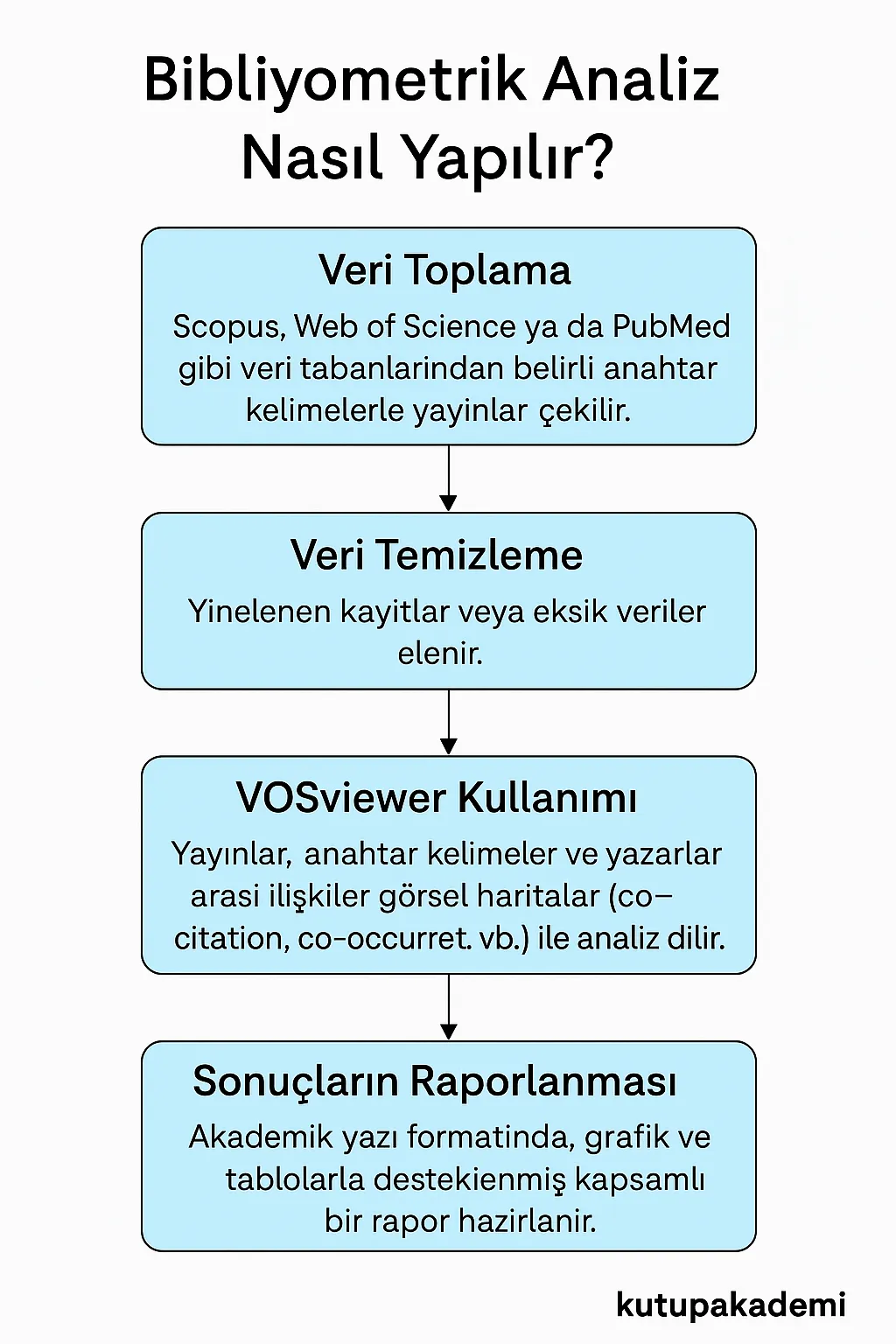
The question how to perform bibliometric analysis? is the basic question that many researchers new to this field wonder about. The process generally includes the following steps:
Data Collection
- The subject to be covered by the research is determined and an appropriate time interval is selected.
- Filtering is done according to a specific field, key phrases or conceptual framework.
- Bibliographic information is collected from electronic scientific publication pools (e.g. peer-reviewed journal databases).
- Records containing basic information such as publication titles, abstracts, author names, published journal, publication year and keywords are prepared.
Data Cleaning
- Repeated or incompletely recorded records in the collected data are eliminated.
- Structural distortions that may disrupt analysis results are corrected (for example, situations such as the same author appearing under different names are corrected).
- A data set ready for use, consistent and complete is obtained.
- This stage requires care as it directly affects the accuracy and validity of the final maps.
Using VOSviewer
- The cleaned data file is transferred to special software.
- Author-author relationships, term-term proximities or publication-publication interactions are visually analyzed.
- Graphical outputs are created with conceptual clusters, network maps, density maps and time-based analyses.
- Understandable and presentation-appropriate content is prepared by making visualization settings.
Reporting Results
- Visual maps and analysis results are organized in accordance with academic standards.
- Connections with the literature are established in the interpretation process and the contribution of the findings to the field is emphasized.
- A comprehensive report supported by tables, graphs and descriptive sections is created.
- The report can be presented as a thesis chapter, a scientific article or a project output.
These four basic steps provide a guiding framework for researchers who want to do in-depth literature review and map scientific networks in academic research.
We conduct this process professionally for you.
Bibliometric Analysis Methods and Use of VOSviewer
Bibliometric analysis includes various methods used to understand the structure of literature, see the direction of scientific production and guide future research. Here are the most common bibliometric analysis methods and how they are applied with VOSviewer:
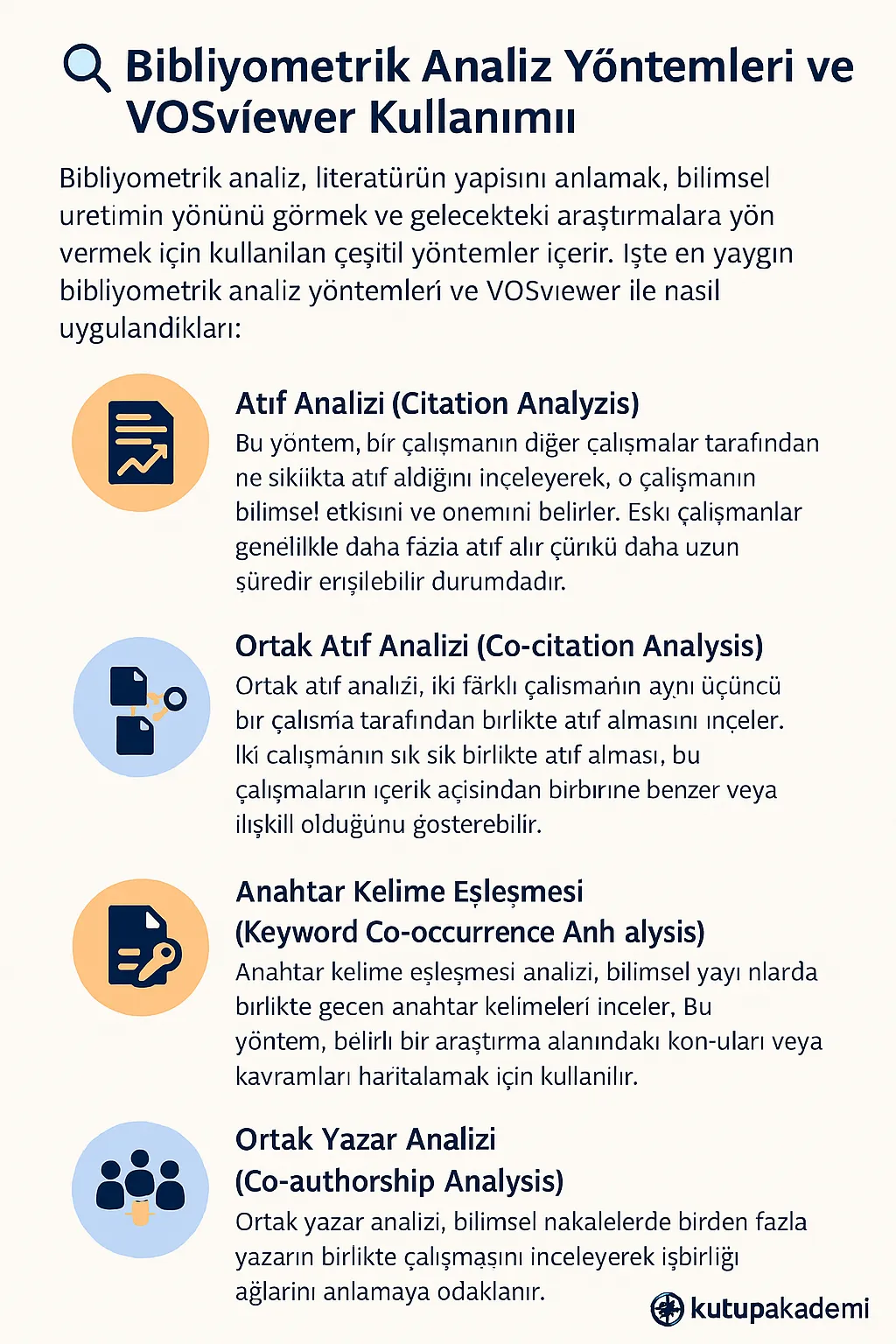
Citation Analysis
This method determines the scientific impact and importance of a study by examining how often it is cited by other studies. Citation analysis is used to understand which articles or research are most influential in a field. Older studies generally receive more citations because they have been accessible for a longer time.
Co-citation Analysis
Co-citation analysis examines the citation of two different studies together by the same third study. The fact that two studies are frequently cited together may indicate that these studies are similar or related in terms of content. This method is used to reveal the intellectual structure and thematic clusters in a research field.
Keyword Co-occurrence Analysis
Keyword co-occurrence analysis examines keywords that appear together in scientific publications. This method is used to map topics or concepts in a specific research field. The frequency of keywords appearing together reveals the density and relationship of related themes.
Co-authorship Analysis
Co-authorship analysis focuses on understanding collaboration networks by examining the collaboration of multiple authors in scientific articles. This method is used to understand collaboration dynamics between researchers and the structure of scientific communities. It is also useful for evaluating international or inter-institutional collaborations.
Who Is It Suitable For?
- Master's and doctoral students: Those who want to provide a solid foundation for literature analysis in their theses
- Academics: Those who want to identify gaps in the field in their articles or prepare a systematic study to submit to a journal
- Those preparing research projects: Those who want to create correct strategies with field analysis and subject mapping
You are on the right track to increase the visibility of your academic production.
Scope of Bibliometric Analysis Consulting
- Reviewing search strategy and data-export settings
- Using a thesaurus file to clean author, institution, and keyword names
- Justifying network type, counting method, and threshold values
- Explaining how to read network, density, and overlay visualizations
- Feedback on the researcher’s own methods and findings text for transparent reporting
Frequently Asked Questions (FAQ)
Is bibliometric analysis qualitative or quantitative?
Bibliometric analysis is fundamentally a quantitative research method. Analysis is done on numerical data such as publication numbers, citation frequencies, keyword frequency. However, results can be supported by qualitative analyses.
With which programs is bibliometric analysis done?
The most commonly used programs include VOSviewer, CiteSpace, BibExcel, R (bibliometrix package) and Gephi. VOSviewer is especially preferred for its user-friendly interface and visual mapping features.
What are examples of bibliometric analysis?
As examples:
- "Publication trends in the field of artificial intelligence in the last 10 years",
- "Scientific collaboration networks related to COVID-19",
- "Academic impact and citation analysis of an author" are examples of bibliometric analysis.
Applied VOSviewer Guidance
You can receive applied consulting on VOSviewer setup, data cleaning, mapping, and output interpretation while conducting your own bibliometric analysis. Share your need and learning objective through the price request form.