

Collecting data with the right tools is of great importance to increase the validity and reliability of scientific research. At this point, scale development has become one of the cornerstones of research, especially in the fields of social sciences and educational sciences. So, do you need a special scale development process for your thesis or academic study? By getting professional support, you can carry out this process both saving time and in accordance with scientific ethical principles.
What are the Stages of Scale Development with SPSS?
One of the most important factors determining the scientific value of a research is that the measurement tool is valid and reliable. In this context, an original scale development study not only achieves academic success, but also opens the door to producing a permanent work that will contribute to the field literature.
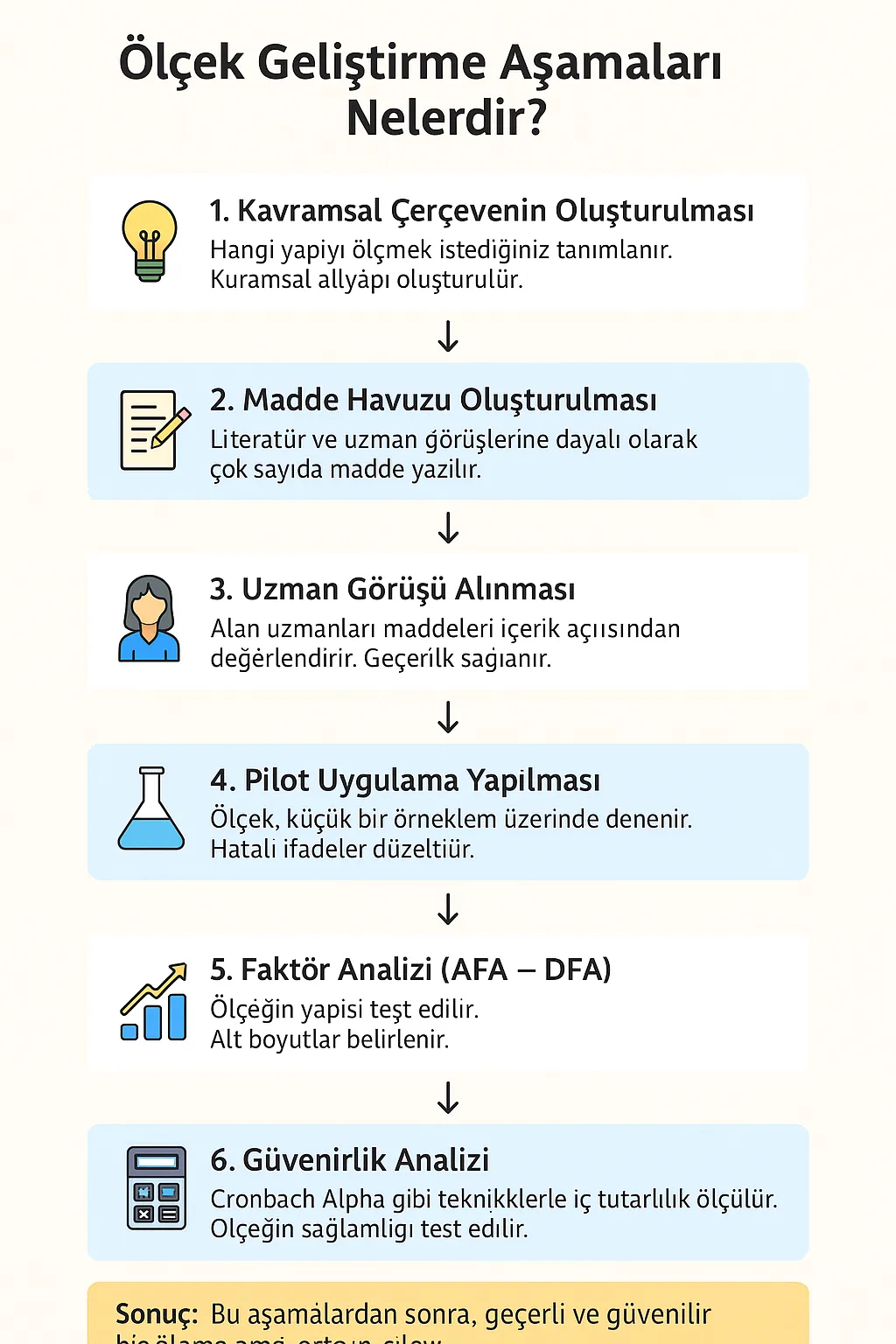
However, this process is not just about writing a few questions. On the contrary; it requires careful planning, theoretical knowledge, statistical analysis skills and adherence to ethical principles. Here are the scale development stages carried out within the scope of professional service:
1. Creating the Conceptual Framework
Everything starts with a question: "What do I want to measure?"
The first step is to create the theoretical framework of the structure to be measured (e.g., academic motivation, digital literacy, social anxiety). In this process, literature review is done, the dimensions of the concept are determined and which features will be measured are clarified. A strong conceptual foundation increases the scientific value of the scale.
2. Creating an Item Pool
Many items are produced in accordance with the conceptual framework. These items:
-
Should be clear and understandable
-
Should be balanced in positive and negative forms
-
Should not contain biased, directive or contradictory expressions
During item writing, inspiration can be taken from items in similar studies, but plagiarism should be avoided. Linguistic sensitivity and suitability to the target audience are very important at this stage.
3. Ensuring Content Validity with Expert Opinions
The created item pool is evaluated by at least 3-5 field experts. Experts:
-
The suitability of items to the concept to be measured
-
Linguistic consistency
-
Level of comprehensibility
-
Suitability to dimensions
analyze and give feedback. In this way, content validity is ensured and necessary revisions are made to the items.
4. Pilot Application and Pre-Tests
The edited scale is tested on a small group similar to the target audience (for example, 30-50 people). The purpose is:
-
To see if the items are understandable
-
To determine average response times
-
To identify inconsistencies or technical problems
Item revisions are made in line with the feedback obtained from the pilot study and the final version for the main application is created.
5. Factor Analysis with SPSS (EFA and CFA)
After the data is collected, first Exploratory Factor Analysis (EFA) is performed to determine which factors (dimensions) the scale consists of. Then, the accuracy of this structure is tested by performing Confirmatory Factor Analysis (CFA) with a different sample.
At this stage, research data is usually analyzed with statistical software such as SPSS, AMOS or Jamovi. Obtaining high factor loadings and model fit indices (CFI, RMSEA, SRMR, etc.) shows the structural validity of the scale.
6. Reliability Analyses with SPSS (Cronbach Alpha, Test-Retest, etc.)
A valid scale must also be reliable. For this reason:
-
Cronbach Alpha coefficient for internal consistency,
-
Test-Retest method for stability over time,
-
Item-total correlations for the contribution of each item
are evaluated. Generally, a Cronbach Alpha value of .70 and above is considered satisfactory.
7. Reporting Results and Writing in APA Format
After all analyses are completed, the obtained findings are reported in an academic style. In accordance with APA 7 rules:
-
The scale development process is described in detail
-
Analysis results are supported with tables and graphs
-
Comparisons are made with the literature in the discussion section
-
Limitations and recommendations are presented
This report can be used as a chapter of your thesis or sent to a peer-reviewed journal as an article.
Why Should You Get Professional Service for Scale Development Study?
Scale development is not just preparing a questionnaire; it is a multi-layered scientific process that requires theoretical depth, methodological sensitivity and statistical accuracy. To carry out this process correctly and effectively, time, experience, technical knowledge and analysis tools are needed. However, many graduate students, academics or researchers may not have all of these resources at the same time.
At this point, getting professional support strengthens your research process both scientifically and practically.
1. Time Management and Efficiency
The scale development process consists of long and detailed steps from literature review to pilot application, from data analysis to reporting. Trying to carry out this entire process on your own can cause time losses that can take months.
Professional service allows you to complete the steps in the process faster and in a more planned way. In this way, you both meet your thesis submission deadline and complete your research without disrupting your other academic obligations.
2. Scientific Accuracy and Quality Assurance
An incorrectly structured scale can cause the collected data to lose its meaning. Problems such as incorrect item writing, incomplete factor analysis or low reliability coefficient can lead to your thesis or article not being accepted.
With expert support:
-
The theoretical framework is structured correctly
-
Analyses such as EFA and CFA are performed appropriately
-
Validity and reliability criteria are in accordance with scientific standards
In this way, your study is elevated to the highest level in terms of scientific quality.
3. Acceptance Chances Increase in Thesis, Article and Publication Process
Academic advisors, jury members and referees accept not just "done" but scientifically sound studies. Scales with incomplete or incorrect analysis are usually rejected or corrections are requested.
Scale development reports prepared with professional support:
-
Pass the advisor's approval more easily
-
Give confidence in thesis jury defense
-
Have publication potential in national and international peer-reviewed journals
4. Technical Equipment and Software Knowledge Requirement is Eliminated
Statistical software such as SPSS, AMOS, Jamovi, R are indispensable parts of the analysis processes. However, using these programs correctly requires a certain expertise. In addition, mastering academic writing rules such as APA can be a separate burden.
With professional consultancy:
-
The right analysis technique is selected
-
Analyses are presented error-free and in academic format
-
Writing language, referencing and reporting are prepared according to international standards
5. Ethical, Original and Reliable Results
Many students have concerns such as "is it ethical?", "is it original?", "will my advisor notice this?" when receiving scale development service. A quality consultancy service answers these questions transparently and carries out the process with you, not on your behalf, with your contribution.
In this process:
-
Your confidentiality is protected
-
The scale is developed specifically for you
-
Progress is made with your approval at every step
-
Full compliance with academic ethical rules is ensured
Conclusion: Scientific Quality, Time Saving, Publication Potential
In summary; when the scale development process is carried out with a professional approach:
- In a shorter time,
- With less stress,
- With higher scientific quality,
- With more acceptance and publication chances
it is completed.
Scale Development Article Preparation Support
The scale development process is not limited to producing only a valid and reliable measurement tool. The academic value of this process also emerges by being transformed into a scientific publication or thesis chapter. That is, the scale you have developed should be of a quality that can be integrated into a scientific report, your master's or doctoral thesis.
However, most researchers have difficulty converting the analyses they obtained at the end of this process into correct academic writing. Texts that are incomplete or erroneous in terms of both writing rules and scientific structure are not accepted by thesis advisors or peer-reviewed journals. At this point, our scale development article preparation support offers a strong solution in carrying the process to the academic field.
In Which Areas Do We Provide Support?
1. Thesis Chapter Writing
The "Method", "Findings", "Discussion" and "Conclusion" sections of your scale development study are prepared in accordance with academic writing rules such as APA 7, MLA, Chicago. Analysis results are supported with tables and graphs, statistical findings are reported correctly.
2. Academic Article Preparation
Your scale is structured to be published in national or international peer-reviewed journals. Relationship with literature, theoretical framework, analysis explanations, discussion and recommendation sections are presented in complete integrity.
3. Report Format Publication Preparation
For situations that require non-academic but scientific reporting, a report is prepared in a simple, easy-to-read and visualized format. This is especially preferred for in-house projects, academic portfolios or project applications.
Academic Standards We Pay Attention To
-
Compliance with writing systems such as APA 7, MLA, Chicago
-
Detailed presentation of validity and reliability findings
-
Explanatory interpretation of EFA and CFA analyses
-
Ethical statement, limitations and recommendations for future studies
-
Reference formatting and production of plagiarism-free content
International Level Preparation for Your Publication Applications
If you want to publish the scale you developed in a peer-reviewed journal, not only statistical analysis is not enough. Structural integrity, academic style and strong literature support appropriate to journal criteria are needed. We are with you in such writing processes. We especially offer consultancy on the following subjects:
-
Journal selection and targeting
-
Editing the article structure according to the journal
-
Cover letter preparation
-
Supportive feedback writing for revisions
Scale Adaptation Stages
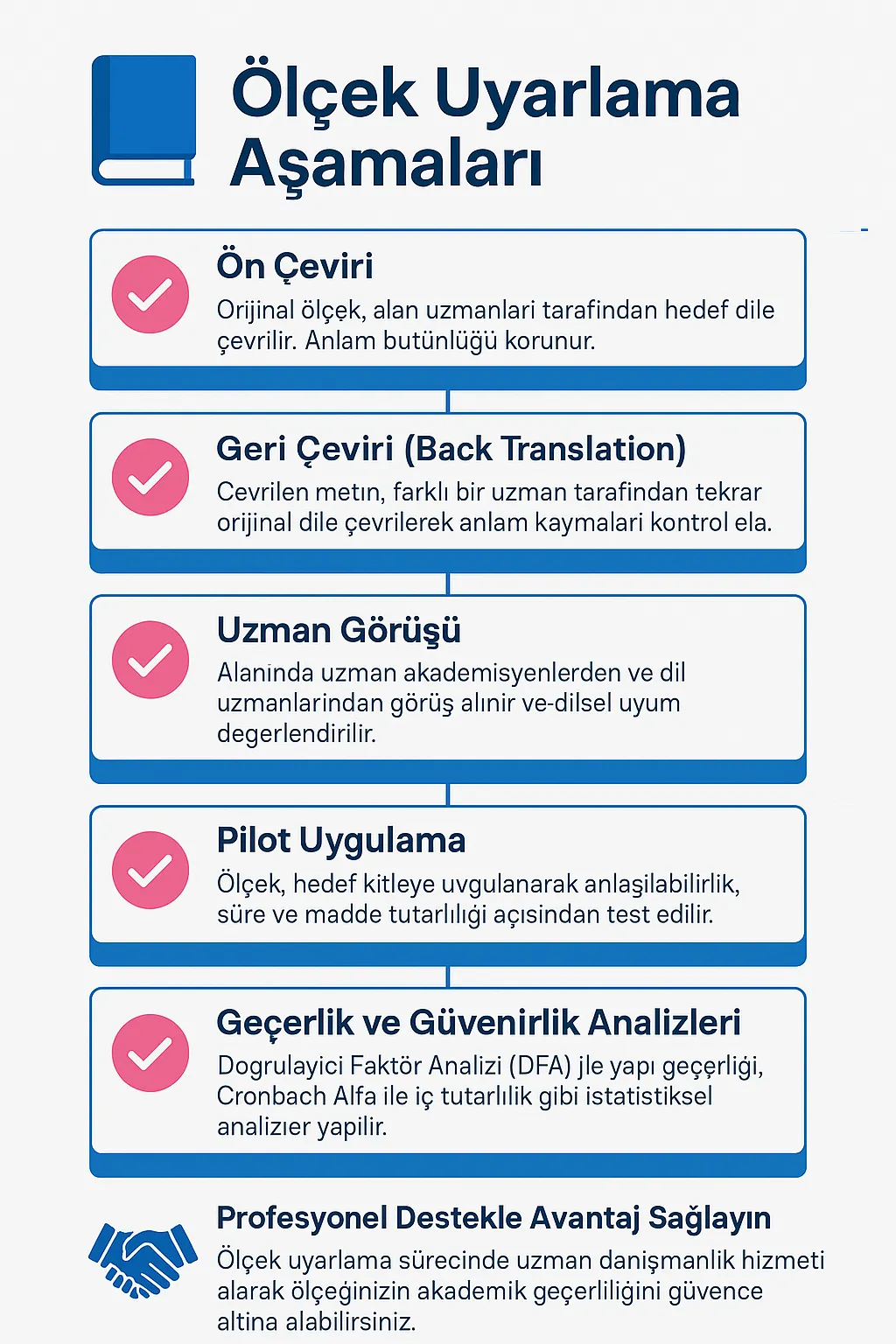
In order for scales used in academic research to be used by preserving their validity in different languages and cultures, the scale adaptation process is of great importance. If you want to adapt an existing scale in the literature to your own research, you need to carefully follow the following stages:
1. Initial Translation
The original scale is translated into the target language by field experts. Technical and academic suitability is ensured by preserving meaning integrity.
2. Back Translation
The translated text is translated back to the original language by a different expert to check for semantic shifts.
3. Expert Opinion
Linguistic and conceptual harmony is evaluated by taking opinions from academics and language experts who are experts in the field.
4. Pilot Application
The scale is applied to the target audience and tested in terms of comprehensibility, time and item consistency.
5. Validity and Reliability Analyses
Statistical analyses such as structural validity with Confirmatory Factor Analysis (CFA), internal consistency with Cronbach Alpha are performed.
Gain Advantage with Professional Support
The scale adaptation process requires high attention and expertise both linguistically and statistically. Incorrect applications can reduce the scientific value of your research. For this reason, you can guarantee the academic validity of your scale by receiving expert consultancy service.
Problems Encountered in Scale Development and Adaptation Studies
Unfortunately, many researchers face the following problems:
-
Inadequate item writing
-
Incorrect application of analysis techniques
-
Inappropriate sample selection
-
Errors in APA format
-
Not getting advisor or jury approval
To eliminate these risks, receiving experienced consultancy service is a very appropriate choice.
Table 1. Comparison Table: Scale Development vs. Scale Adaptation
| Feature | Scale Development | Scale Adaptation |
|---|---|---|
| Definition | A new measurement tool is created from scratch | An existing scale is adapted to a different language/culture |
| Purpose | To develop an original scale to measure a specific structure | To make the existing scale valid in another culture |
| Stages | Concept determination, item writing, EFA, CFA, reliability | Translation, back translation, expert opinion, pilot test, analysis |
| Time and Cost | Takes longer, more costly | Relatively shorter and lower cost |
| Publication Potential | High; more preferred in academic publications | Medium level; adaptation studies can also be published |
| Creativity Requirement | High (requires item production and structuring) | Low (adherence to existing structure) |
| Data Analysis | EFA and CFA are mandatory | Usually CFA and fit indices are sufficient |
| When to Prefer? | If there is no similar measurement tool or an original structure is needed | If you want to measure the same structure in a different population |
Frequently Asked Questions (FAQ)
1. Which areas does your scale development service cover?
We provide scale development and adaptation support in many fields, especially social sciences such as educational sciences, psychology, sociology, health sciences, management and organization. Theoretical framework and analysis method specific to your field is determined.
2. Can I get support only at the analysis stage?
Yes. We also provide support only in technical analyses such as Exploratory Factor Analysis (EFA), Confirmatory Factor Analysis (CFA), reliability tests (Cronbach Alpha, test-retest, etc.).
3. Is your scale development service original?
Absolutely. Each scale study is specially designed only for your research. No ready templates or copied content are used. The process is carried out entirely in an original, ethical and academically valid manner.
4. How long does the process take?
The process varies according to the scope of the request, your field, data collection speed and the type of analysis to be performed. On average, a full-scope scale development service is completed in 2-4 weeks. Fast delivery options are also available.
Conclusion: Take a Professional Step in the Scale Development Process
If you need a specially designed scale development or adaptation process for your thesis, article or scientific research, you are in the right place.
At every stage of your academic journey; from conceptual framework to item writing, from analyses to APA-compliant writing, we offer you a special and original consultancy service. Our goal is not just to provide technical support; but to contribute to producing studies that have scientific value, are valid and reliable. Contact Us for Valid, Reliable and Publication-Ready Scales!
The scale development and adaptation process is a multi-layered study that requires detailed statistical analyses and reporting in accordance with academic standards, not limited to just writing questions. At this point, SPSS software is an indispensable tool throughout the process from validity-reliability tests to factor analyses.
If you want to develop an original scale or adapt an existing scale in your thesis or academic study under expert guidance, review our SPSS Consulting service. Consulting mentors researchers as they understand methodological decisions and improve their own work under scientific standards.
Researchers seeking teaching-focused support on data preparation, assumption checks, and analytical options can review our SPSS Data Analysis guide. Analytical decisions, academic interpretation, and the final text remain the researcher’s responsibility.
If you want to learn the scale development process and apply analyses independently, review Learning Data Analysis with SPSS Training. You can practice with examples and improve analysis interpretation and reporting skills.